Raffrescatore Art-Eco
Raffrescatore Biemmedue
Raffrescatore CFG
Raffrescatore Edenya
Raffrescatore EGO
Raffrescatore Fral
Raffrescatore Hyundai
Raffrescatore Jhcool
Raffrescatore KALTERMANN
Raffrescatore Master
Raffrescatore MO-EL
Raffrescatore PROCOOL
Raffrescatore StarProgetti
Raffrescatore Vinco

Best Sellers

New Arrivals

Buying Guide

Evaporative Coolers: A Complete Buying Guide

Evaporative coolers use a natural cooling principle based on water evaporation . Unlike traditional compression air conditioning systems, the evaporative cooling process does not use a refrigeration cycle with a compressor and refrigerant gas.

This technology is an ideal solution for cooling well-ventilated, open or semi-open environments and in all situations where constant air exchange is required.

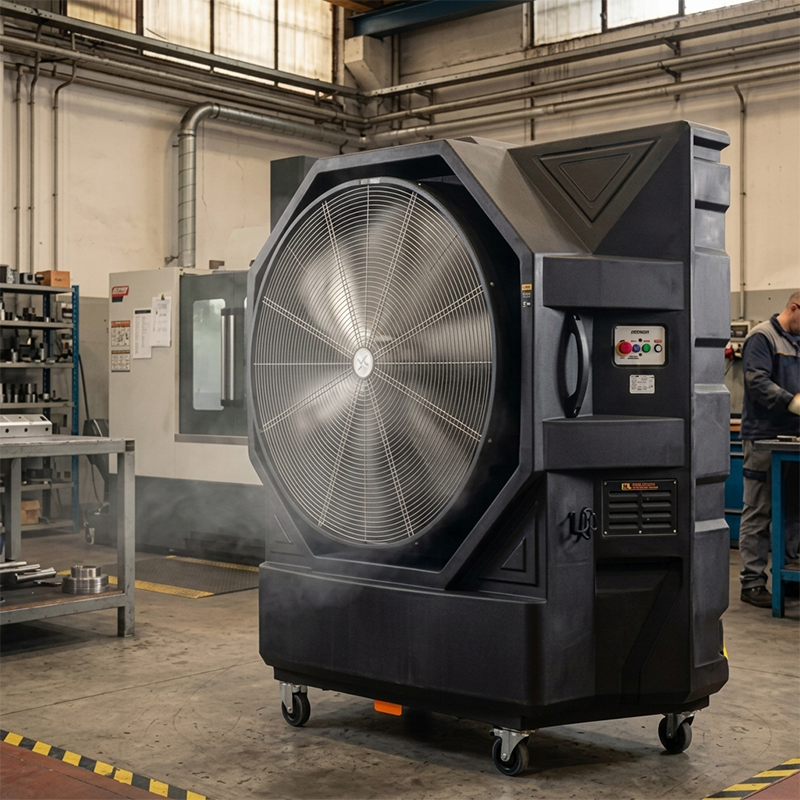
Evaporative coolers can be used, depending on the characteristics of the system and the environment, in warehouses, workshops, warehouses, porches, tensile structures, commercial spaces and other environments where traditional cooling may be less suitable and expensive, both economically and in terms of sustainability.
Evaporative cooling is generally most effective when the air is relatively dry and requires adequate air exchange, as the air increases its moisture content during the process.

How an Evaporative Cooler Works

Evaporative cooling uses a simple physical principle: when water evaporates, it absorbs heat from the surrounding air.
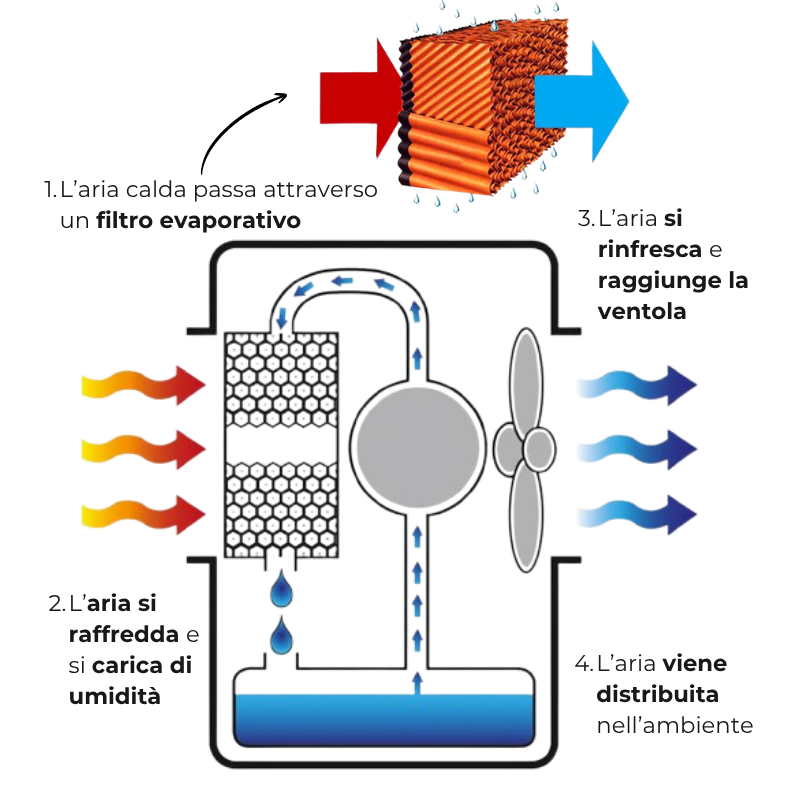
Inside the cooler, air is passed through an evaporative pad kept moist by water. During this passage, some of the water evaporates and extracts heat from the air , which is then released into the room at a lower temperature and with a higher humidity content.

In simplified terms, the process occurs in four phases:

  • Air is sucked in by the cooler
  • Air passes through the wet evaporative pad
  • The evaporation of water removes heat from the air
  • The fan distributes the cooled air throughout the room

The effectiveness of the process depends on several factors, including the temperature and humidity of the air , the characteristics of the evaporative panel , the air flow rate and the ventilation conditions of the room .
Many coolers use evaporative panels designed to increase the contact surface between air and water: a larger exchange surface can favor the evaporation process, all other things being equal.

evaporative cooler operation

When to choose an evaporative cooler

An evaporative cooler can be a suitable solution especially when:

  • the environment has adequate air exchange
  • it is necessary to cool open, semi-open or large spaces
  • climatic conditions favor the evaporation process
  • it is not necessary to maintain a precise level of temperature and humidity
  • you want to evaluate a cooling system other than traditional air conditioning

Conversely, evaporative cooling may be less suitable in closed environments with poor ventilation or high humidity conditions, as the process introduces additional moisture into the air and its cooling capacity decreases as the relative humidity increases.

evaporative cooler operation

How to choose the most suitable cooler

To correctly choose a cooler it is important to evaluate:

  • Volume of the room to be cooled
  • Air flow rate generally expressed in m³/h
  • Type of environment , open, semi-open or closed and ventilated
  • Climatic conditions , especially temperature and humidity
  • Number of people and heat sources present
  • Installation mode , portable or fixed
  • Water availability and feeding methods

Correct sizing is essential: the nominal air flow rate alone is not sufficient to establish the suitability of a cooler without considering the specific characteristics of the environment.

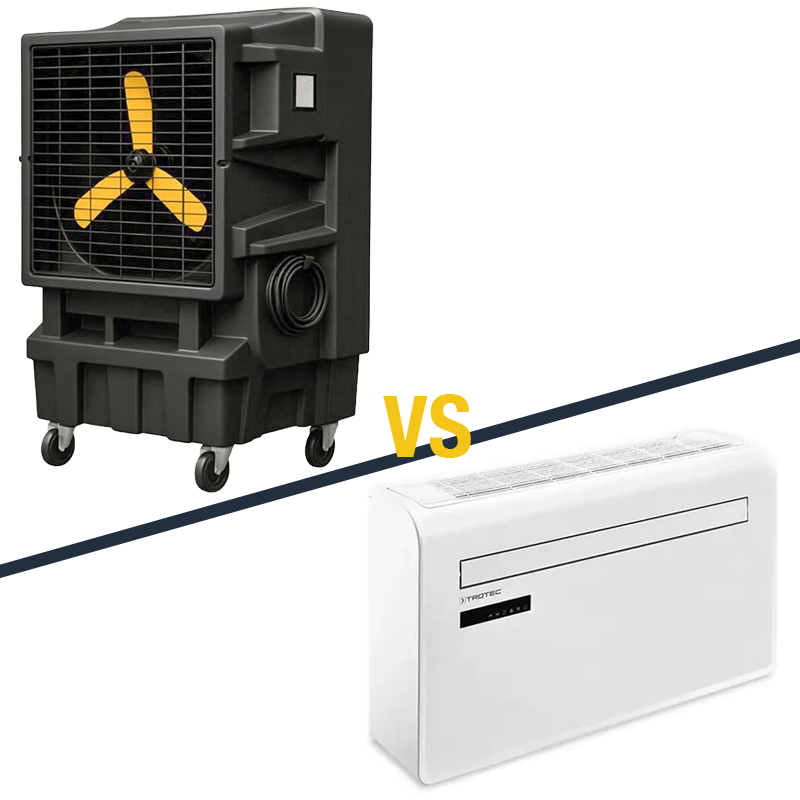
Difference between Evaporative Coolers and Air Conditioners

Evaporative coolers and air conditioners use different technologies.
Air conditioners typically use a refrigeration cycle to extract heat from the environment and release it outdoors. Evaporative coolers, on the other hand, cool the air through the evaporation of water.

This difference leads to different ways of using them:

  • The evaporative cooler uses water for the cooling process.
  • During operation, the humidity content of the treated air increases
  • Requires adequate environmental and ventilation conditions
  • It does not use a refrigeration compressor to perform the evaporative cooling process

Compared to traditional air conditioners, coolers use a natural cooling principle that does not require refrigerant gases or expensive compressors. This translates into savings on purchase costs and electricity consumption , with significant benefits even in the short term. For example, a 3,000 m³/h cooler consumes less than 300 W and approximately 6-8 liters of water per hour. This represents a 90% reduction in installation costs and a 75% reduction in operating costs compared to air conditioners.

evaporative cooler operation

Advantages of Evaporative Coolers

Ensures continuous and frequent air changes

The powerful fan mounted on the coolers ensures a high number of air changes (it is normally calibrated to replace the air approximately 20-25 times per hour) and this keeps the environment healthy and constantly eliminates fumes and unpleasant odors from the air.

Low management costs

The fan and water pump consume very little electricity. Installation and maintenance are extremely simple, and costs are extremely low compared to traditional air conditioning systems.

Very easy to install

Installation requires only a water connection (if applicable) and an electrical connection. If wall-mounted or roof-mounted, only a special bracket is required; otherwise, they're easily transportable like any other wheeled device. No special licenses or permits are required for installation of coolers.

Easy to maintain

Maintenance is very simple as it essentially consists of cleaning the water tank and evaporative panel once a year.

They improve productivity

Qualified researchers have demonstrated how more favorable climatic conditions within the workplace can improve worker comfort and therefore enhance productivity. According to a NASA study, productivity drops by 29% at 32°C (45% at 35°C), and the possibility of operator error is three times higher than under normal temperature conditions (15°C-20°C).

Application Examples

Depending on the environmental conditions and the correct sizing, evaporative coolers can be applied in numerous contexts, including:

  • Warehouses and logistics areas
  • Manufacturing companies;
  • Workshops and laboratories;
  • Wood industries;
  • Paper mills and printing houses;
  • Foundries and production areas;
  • Production plants;
  • Compressor rooms;
  • Tensile structures;
  • Restaurants, bars and event spaces;
  • Adequately ventilated meeting rooms and exhibition spaces;
  • Showrooms and commercial spaces;
  • Processing areas where increased air humidity is compatible.